
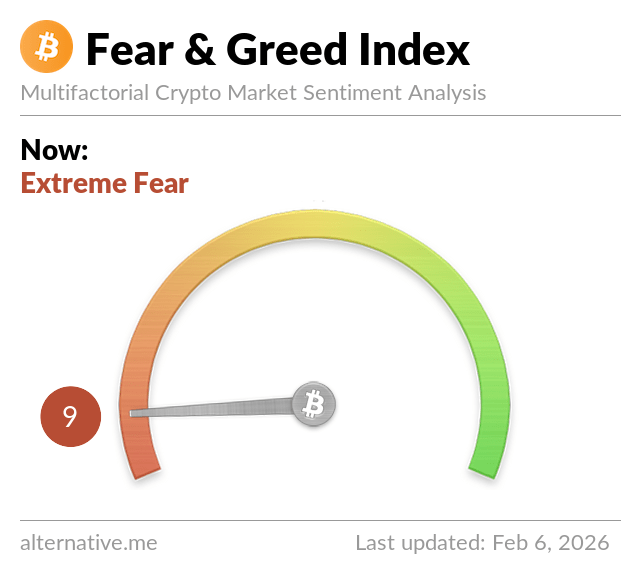
Bitcoin has fallen to a low of approximately $60,000, its lowest point since October 2024, as cryptocurrency market sentiment plummets to its weakest level in over three and a half years. The Crypto Fear & Greed Index registered a score of 9 out of 100 on Friday, indicating “extreme fear” and marking the lowest point since June 2022, when the market experienced a significant downturn following the collapse of the Terra blockchain.
The leading cryptocurrency has seen a dramatic decline, shedding 38% from its 2026 high of $97,000 within just three weeks and erasing all gains from the past sixteen months. Over the past 24 hours, Bitcoin has dropped by 13%, losing over $10,000 in its largest daily decrease since mid-2022. This significant price drop has also seen Bitcoin fall below its 200-week exponential moving average, a key long-term trend indicator, a phenomenon that has historically occurred only during the depths of a bear market.
Market Sentiment at Historic Low
The Crypto Fear & Greed Index, a tool that measures prevailing sentiment in the cryptocurrency market, has fallen to a score of 9, signaling extreme fear among investors. This level has not been seen since June 2022, a period marked by major industry collapses including Terra, Three Arrows Capital, and Celsius. The index ranges from 0 (extreme fear) to 100 (extreme greed), with current readings suggesting a significant shift towards pessimism.
Over the last 24 hours, more than 588,000 traders were liquidated for approximately $2.7 billion, with 85% of these liquidations being leveraged long positions, predominantly in Bitcoin. This highlights the intense selling pressure and the impact of the price drop on highly leveraged market participants.
Broader Economic Factors Contribute to Crypto Downturn
Analysts attribute Bitcoin’s sharp decline not only to internal market dynamics but also to broader macroeconomic trends. Jeff Ko, chief analyst at CoinEx Research, noted that the current sell-off in Bitcoin coincides with a downturn in U.S. tech stocks. He pointed to stretched valuations and concerns about an “artificial intelligence-driven bubble” as contributing factors in the tech sector, citing Amazon’s double-digit decline following a mixed earnings release as an example. Ko added that investors are increasingly questioning Bitcoin’s efficacy as a safe-haven asset when compared to gold.
Nick Ruck, director at LVRG Research, linked Bitcoin’s fall and the wider market decline to “heightened risk aversion.” This sentiment is reportedly triggered by “softer U.S. job market signals,” including rising unemployment claims, which cast doubt on the sustainability of economic strength and may prompt caution from the Federal Reserve regarding aggressive interest rate cuts. Recent labor market data from October 2024 indicated a slowdown in job growth, with only 12,000 net jobs added, and rising unemployment claims, contributing to this cautious outlook.
Historical Context and Technical Indicators
Bitcoin’s current price drop is significant when viewed against historical data and technical indicators. The cryptocurrency has fallen below its 200-week exponential moving average, a long-term trend indicator that has previously only been breached during major bear markets. This indicator is often used to gauge the long-term health of Bitcoin’s trend, with prices consistently above it suggesting a bullish trend and prices below indicating a bearish one. The price is also approximately 50% down from its all-time high of $126,000 reached in early October 2025.
The lowest point reached on Coinbase was just over $60,000 in early trading on Friday morning, according to TradingView data. As of Friday morning, Bitcoin was trading at just over $64,000, having experienced a significant 13% drop in the preceding 24 hours.